Mission Street is a specialist investor, developer and operator for the science and innovation sector. The company’s science and innovation portfolio of over 1 million sq ft (93,000 sq m) extends to Cambridge, Oxford and Bristol. Mission Street have also been active as development managers
(for example, on Sycamore House in Stevenage, which featured in the 30 September 2022 edition of Life Sciences Real Estate).
We caught up with founder and CEO Artem Korolev in his office in London’s West End.
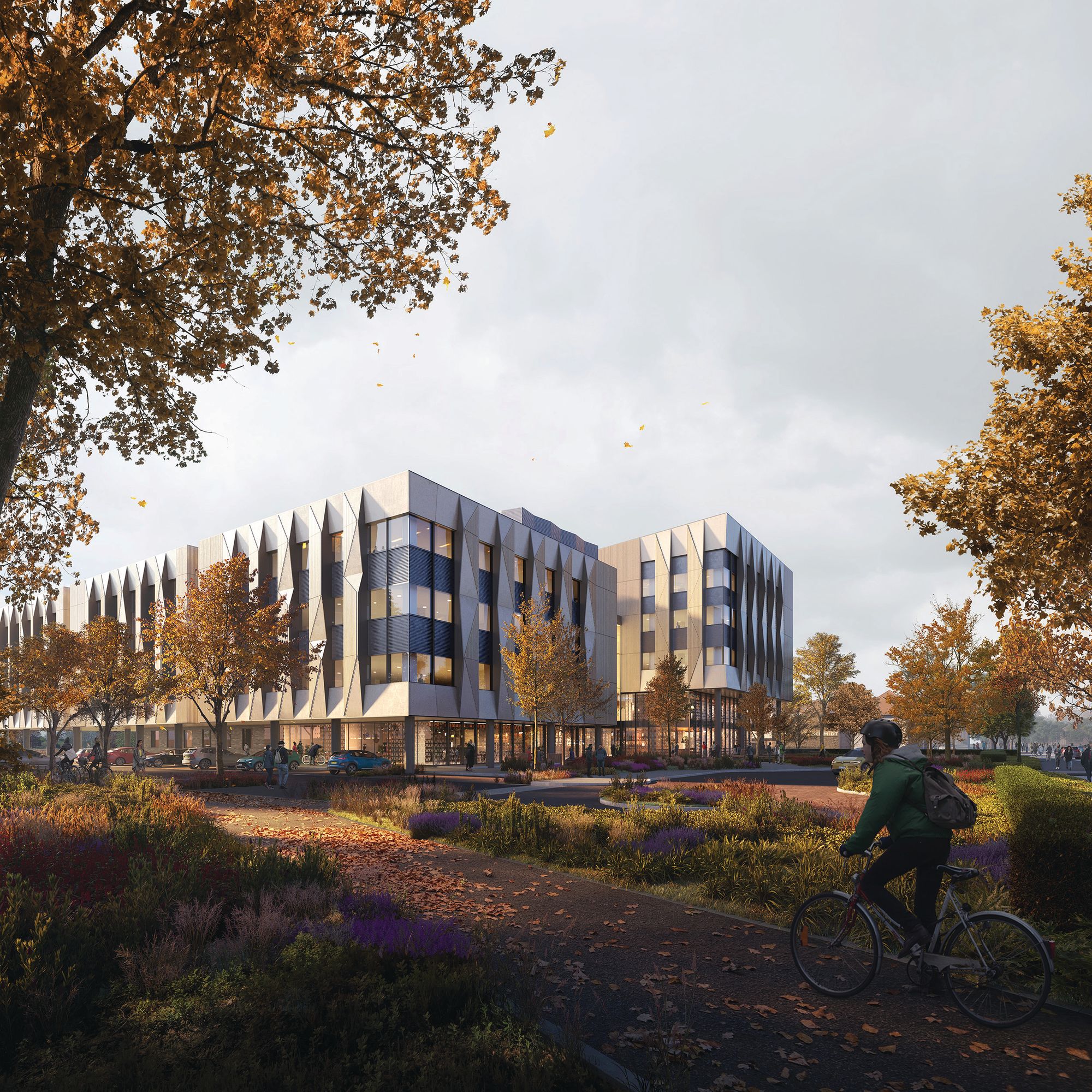
Phase 2 of new science hub for Central Oxford (source: Mission Street)
How could the life sciences and real estate sectors work better together?
Some of the major challenges at the moment are that the real estate and sciences sectors work at different paces. Growth of knowledge intensive businesses is often extremely rapid, whilst the development cycle usually
takes several years – so we need to take a view on future evolution
of our ecosystems. Secondly, real estate can often become an echo chamber driven by pre-conceived notions of best practice which are siloed from the wants of the ultimate customers.
To bridge the gap on these points, continuous active engagement between the science and real estate sectors is critical. Beyond this constant engagement, we are lucky to have an advisory board curated with leading founders and VCs. Finally, understanding the customer supports the “soft
infrastructure” that is layered on to the physical buildings in terms of
operational/technical support and the real estate operator’s role as a facilitator, and in terms of networking, events, capital, recruitment.
Do you believe that the physical/built environment can encourage better innovation?
Definitely. It starts with thinking about how a development can integrate into the wider City context and the other key elements/anchors of the
innovation ecosystem there (universities, hospitals, major corporates etc.). We believe the permeability of these edges and choice of location in terms of transport links and connectivity is critical.
Within the space, whether that is a building or a wider masterplan, we need to layer high quality design on the technical requirements of the building to create inspiring work environments. We think a lot about how we encourage
collaboration and chance encounters, considering how people move around the site, how the physical infrastructure facilitates the soft infrastructure,
what amenities we offer, and where we locate them to activate the masterplan. The other point on larger scale development is curating the mix of uses and building typologies (e.g. incubators, larger multi-tenancy buildings, larger pre-lets, manufacturing), how this ties into ecosystem need and where they are located on a particular site.
What have we learnt from Covid-19?
There are two parts to this: the investment part and the physical space part.
1. Covid-19 has rapidly institutionalised life sciences real estate. Prior to Covid it was a niche asset class with limited players, but Covid-19
reiterated the demographic and thematic trends highlighting the opportunity for investors; at the same time the office and retail sectors got a shakeup.
The gulf between asset classes that are operationally intensive (like labs) and operationally less intensive (like offices) narrowed,with the latter now requiring more hands-on management and shorter leases.
2. Regarding the physical space aspect, it was instructive to see how science parks remained relatively busy during the pandemic, even for workers
who were not lab based, as physical proximity was seen as important to collaboration. Covid-19 has demonstrated the need to create high quality
workspaces where people want to be.
Does the ever-increasing importance of sustainability affect Mission Street’s operations or strategy?
ESG has gone from a moral position to a commercial imperative - important for investors, lenders, planners and occupiers.
Regarding environmental considerations, we feel that often accreditations are driving design strategy, rather than focusing on maximising sustainability. Whilst accreditations are an important way of benchmarking,
this approach often results in a ‘tick box’ exercise based on the minimum a developer can get away with, and further, many accreditations are designed for offices and do not work well for labs. We believe it is better to push the design team hard to deliver the most sustainable building in terms of construction and operations first, and then evidence this achievement
through accreditations. We also tend to locate all of our buildings on active public transport nodes, facilitating sustainable travel.
Secondly, it is important to focus on the social aspect of sustainability. Developing facilities segregated from the communities in which they are based will create ‘town vs. gown’ divisions, choke ecosystem growth and are ultimately not sustainable.
The growth of innovation economies often results in major changes and pressures in what are frequently relatively small cities, and their communities need to benefit. Physically this means that innovation is best served by “putting science on show”. We make our sites permeable and allow access to amenities for the public. It means implementing a long-term civic attitude – such as mandating living wages (we are the first to do this in Oxford), ongoing involvement with educational charities/events and schools, and facilitating apprenticeships.
Are wet labs becoming less important as data analytics become more prevalent?
Currently we are seeing an increase in lab demand and in the share of space an occupier uses for labs vs.offices, which is coming from more efficient use of office space post-Covid-19. In terms of future trends, whether companies outsource their laboratory processes will depend on the nature of their science, their business and funding model, and their need to control
IP of these processes (the latter also influencing how companies approach manufacturing and where it is located). We are not seeing a fall in laboratory demand on the current horizon.
There is however an interesting trend in the convergence of life sciences with tech, and independent surveys are suggesting that companies are planning to increase this collaboration. This is something to consider when thinking about location and make-up of science developments.
You have experience with London, Swindon, Cambridge, Oxford, Stevenage and now Bristol. Would you consider expanding outside the UK?
We have established a major presence in the UK over the last five years and this will continue to grow – we want to become the partner of choice for the UK innovation economy and there is a lot of work to do. That said,there are lessons learned from our experiences in the UK that can be applied to other markets and overlaid on local specifics. I would therefore say – watch this space!
Over €200 billion has flowed into European life sciences start-ups and scale-ups over the past decade. This funding is powering innovation and reshaping the sector's real estate.