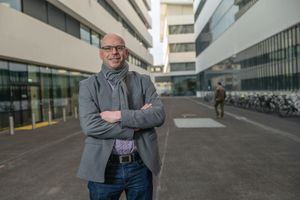
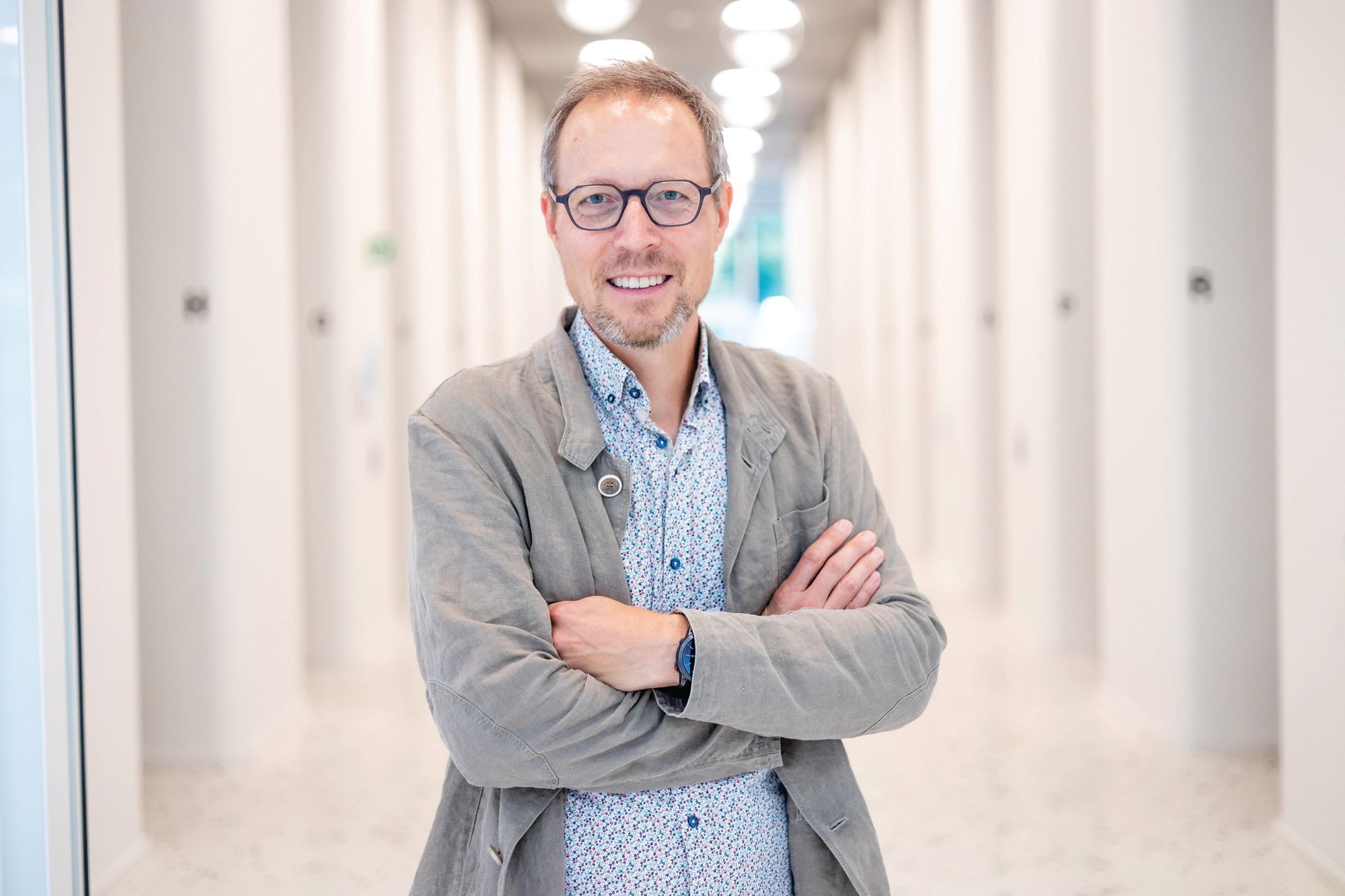
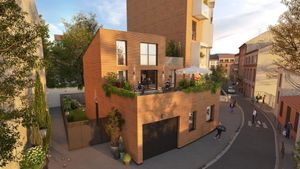
We caught up with Dominik Zaugg and Florian Hofmann Aeschlimann who work in Roche at the company’s headquarters in Basel, Switzerland. Roche is one ofthe world’s largest pharmaceutical companies and has a worldwide staff of over 100,000.
Dominik Zaugg
Tell us about your background and how you came to Roche?
Dominik: I am an architect and I joined Roche about seven years ago. Before that, I worked as a design architect in various firms such as Diener+Diener
Architekten in Basel and then as a project manager for the city of Basel on large hospital projects. My original role at Roche was corporate architect and now I lead the topic of sustainability at the headquarters in Basel.
Florian: I’m also an architect and I started to work at Roche 15 years ago. Before Roche I was working for a General Planner.My first project for Roche was the construction of a production plant. After that I led different projects on the Basel site (Roche headquarters). Dominik and I worked together on several larger projects such as an employee centre, a service and workshop building, the fire department, and the medical centre, as well as many offices. I currently hold the role of Senior Project Manager for
major projects.
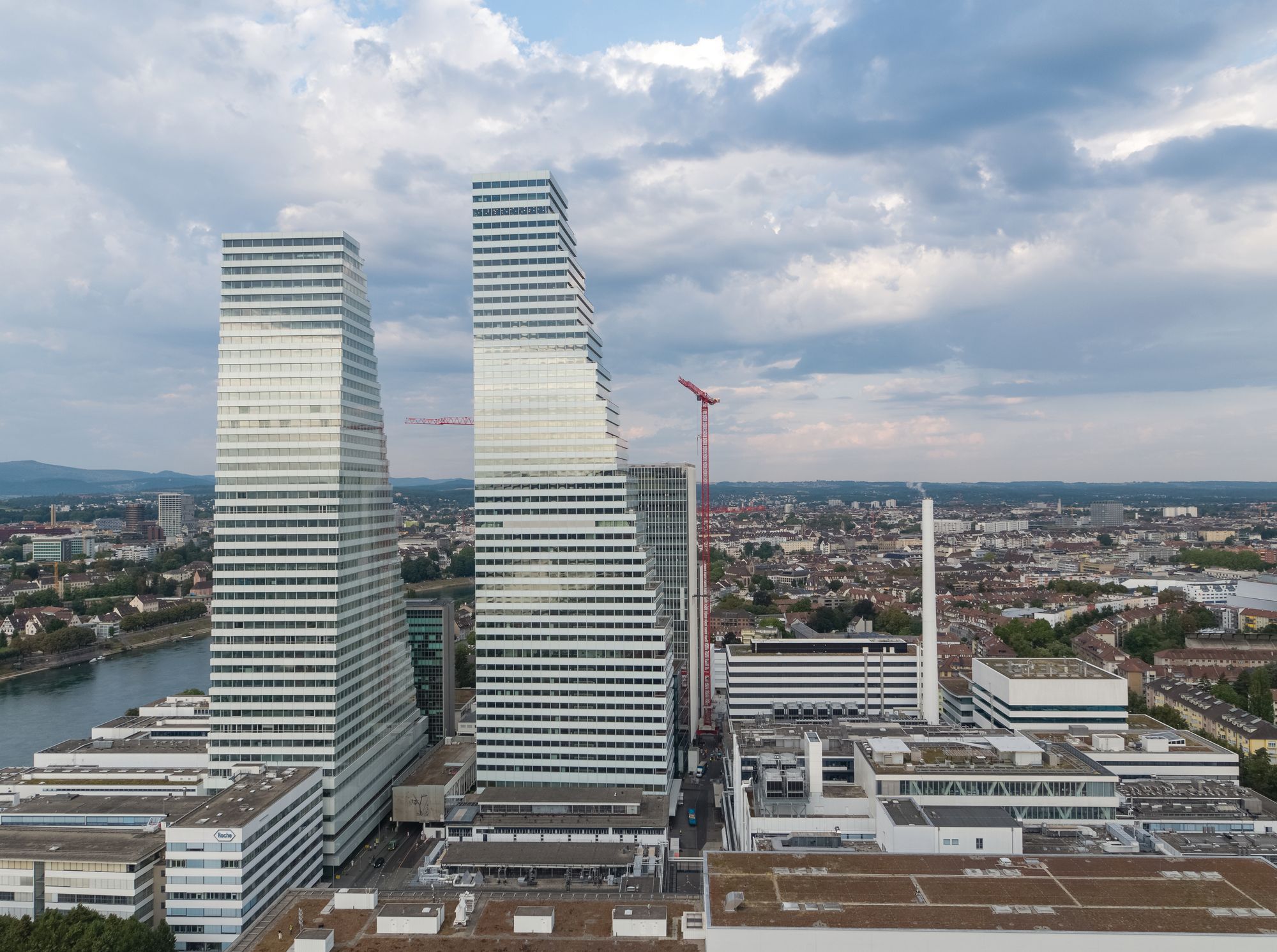
Photo of Roche Headquarters at Basel, Switzerland
How could the life sciences and real estate sectors work better together?
Dominik: Roche’s mission is finding innovative solutions for serious currently unsolved medical problems, and that requires research.In a similar vein, we do real estate research to find new ways and new ideas in the area of construction sustainability. We are not interested in copying and repeating, that is not the Roche culture, and we also apply this
approach when thinking about real estate sustainability.
Florian: We can learn together by thinking through our vision. The buildings we work on today have to last and have to be high quality in 50 years from now. To make the right things for the future we can experiment now. This long-termism and willingness to experiment is, I believe, the key to real estate and science working better together.
How can the physical/built environment encourage better innovation?
Dominik: Employees who are working in healthy green buildings perform better. We have studied the impact of the built environment on performance, and there was a 2 per cent to 3 per cent improvement when employees are in well-lit buildings with good air quality, views, and good acoustics. In addition, having the right building makes it easier to attract and retain staff which in turn is good for innovation. (Investors also get a higher value from these green buildings).
Florian: It is not just about boosting short-term performance – the physical environment we build today needs to last and bring benefits not just to one generation, but all the way to 2050 or even a hundred years into the future. We believe in “Blick nach Vorne” – looking ahead to the future.
What have we learnt from COVID-19?
Dominik: Following the pandemic and the experience of remote working, it is going to be difficult to get people back into the office all the time. You might find that three days out of five or something similar is more common.
Florian: We have learned that we need different sorts of spaces for different tasks. Concentrated individual work can be done at home, for example, but collaborative work needs a shared environment, though it
doesn’t look like the open plan office of years gone by. Even when people are back in the office, they need variety – for example, private spaces as well open and shared spaces. By private space we do not mean cubicles – no
one is interested in returning to Dilbert-style cubicles!
Does the ever-increasing importance of sustainability affect Roche’s operations or strategy?
Dominik: For Roche it’s about doing “now what our patients need next” and that inevitably involves sustainability. Roche is not an NGO bringing
sustainability in all its forms to the world; however, we do wish to bring sustainable initiatives to construction and to be a positive influence. We want to be a front runner in carbon reduction and reaching net zero carbon, for example. Circularity is coming and this will change or even disrupt a lot of today's thinking and processes. That means that the new ways will not be just an updated version or small tweak on the old ways but something more radical.
Florian: As with carbon neutrality, it’s important to undertake pilot projects to evaluate what is possible, and what works. Experimentation prior to starting any construction work is really important.
What is the single thing that most clearly defines a Roche property?
Dominik: We have a passion for sustainable building and good architecture - and we are not trendy. Our focus is always a holistic and embedded approach
to sustainability as well. For sustainability, this means paying equal attention to all three dimensions (ecology, economy, and society).
Florian: We aim for good architecture, high quality construction, and getting the fundamentals (such as energy efficiency and having a low carbon
footprint) right. It is important to us to plan and construct buildings based on the needs of the users - this does not mean that every "wish" is fulfilled, but that we think carefully, and with an eye to the future in terms of requirements and possible development scenarios.
Could you tell me a little more about some recent projects on the Basel site?
Dominik: When you look at the Roche site in Basel, the two towers (Bau 1 is 178 metres tall and Bau 2 is 205 metres tall) are of course the two most prominent buildings, visible from afar. The reason for building the two towers is relatively easy to explain. Until recently, Roche teams and functions were scattered across many different locations in Basel. To change this, Roche has decided to bring the employees back to the "main campus". However, there was only a small footprint on the site itself, so Roche built upwards and is now able to provide all employees with workplaces in close proximity to each other.
Florian: In addition to the two towers, several other important buildings are being - or have been - constructed for the Basel site.The new pRED Center research building will provide space for around 1,800 researchers and
enable new opportunities for collaborative research. Or building 8, which combines workshops and offices - always with the idea of bringing employees together to accelerate our core business of "developing innovative medicine" .And there, too, we have been able to achieve impressive results in terms of sustainable construction: for example, the use of recycled concrete (over 40 per cent in the newer buildings),maximum energy efficiency, recyclable materials and an intelligent data system that transparently locates the materials used in a digital building model.
Can you recall an event or incident that made you change your approach or views?
Dominik: Our views tend to evolve over time rather than in response to any individual event. It is more like a journey where we learn as we go. Real estate and construction are environmentally costly activities – we know for example, that 60 per cent of the world's waste is generated by the construction industry. In other words, if we can find even small solutions to reduce waste, we have great leverage to change "this problem" for the
better. That's our personal drive - to make the world a better place in the
areas where we have responsibility and opportunities.
Florian: Yes, it’s more like a journey or process. The construction industry is relatively conservative, so you need to move step-by-step and try to influence your partners. You also need to think deeply about the questions
you are asking, and you need to be doing experiments as you go, to test your ideas. And as Dominik said before: we should never forget to “walk the talk”, and with this thought in mind, my approach changes automatically and I may (or must) refocus my processes more often.
Over €200 billion has flowed into European life sciences start-ups and scale-ups over the past decade. This funding is powering innovation and reshaping the sector's real estate.